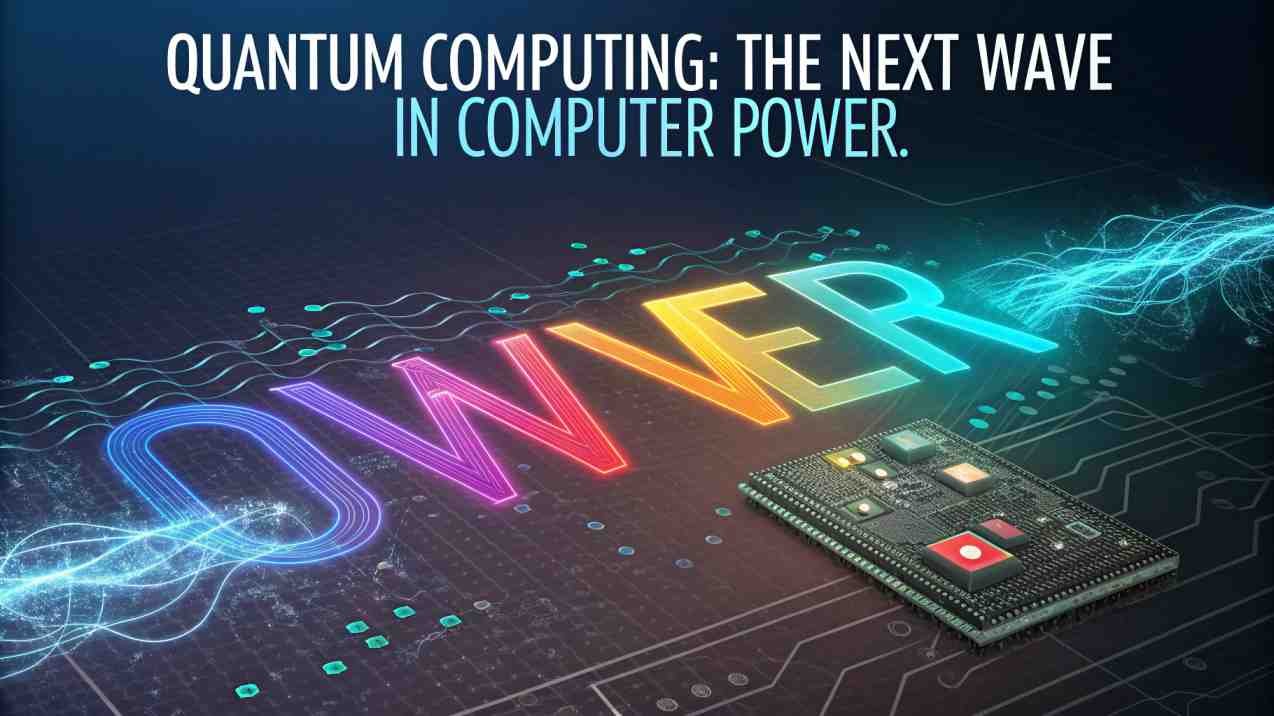
Quantum Computing: the Next Wave in Computer Power.
Ordinary computers are so fast, but they have their limitations. The complexity of some problems is so great that even the world’s most powerful supercomputers could not solve them within millions of years. Quantum computing is an entirely new form of computing that could address some of those issues within seconds. This one is more of a science fiction story, yet quantum computers are already here, and the technology is advancing rapidly.
How Regular Computers Work
To learn about quantum computing, you should learn about the functioning of ordinary computers. Conventional computers store data as bits, small switches that can be either on or off, represented as 1 or 0. All the activities that a computer performs, such as the execution of software programs and even emailing, are reduced to billions of these small on/off calculations at extremely high rates.
Qubits, Superposition, and Entanglement.
Quantum computers operate on quantum bits, or qubits. A qubit can be 1, 0 or both simultaneously due to the property of quantum physics known as superposition. This might seem impossible, but at the subatomic level, particles can be in many states at once until they are observed or measured. This will enable a quantum computer to compute large numbers of possibilities simultaneously, rather than one at a time.
The other quantum property is entanglement, which enables the connection of the qubits in such a way that the state of one would immediately influence the state of the other, regardless of the distance between them. This also increases the processing capacity of quantum computers in a manner that is difficult to compare to conventional hardware.
Practical Implications and Security Concerns.
What then can quantum computers achieve? They are especially optimally adapted to optimization problems, such as the most efficient path among thousands of available paths, or to complex chemical reactions to drug development. The pharmaceutical industry is thrilled by the prospect of quantum computing, which could accelerate drug discovery by a significant margin.
Cybersecurity is also a challenge to quantum computers. Most existing encryption procedures assume that it would take an ordinary computer an impossibly long time to decrypt some of these codes. An intense quantum computer may be able to crack those codes significantly quicker, and that is the reason why scientists are already working on quantum-resistant encryption requirements.
Even at an early stage, quantum computing is the next leap in human computing and can reinvent science, medicine, and industry.